Come visit us at MEDICA 2026 Hall 3 Booth F53. Book a MEETING
Technical Features of 96 Well Plates’ Wells
Quick Answer Box
A standard 96-well microplate holds 8 rows by 12 columns of wells on a 127.76 x 85.48 mm footprint with 9 mm well-to-well spacing, as set by the ANSI SLAS standards. Biomat 96-well plates hold 350 µl in the breakable strip format, 360 µl in the strip format and 400 µl in the solid format, with an internal well depth of 11.1 mm and a recommended working volume of 75 to 300 µl. All three formats are manufactured in Italy in clear, white and black polystyrene, on the same well-holding frames, under an ISO 9001:2015 quality system.
The 96-well microplate is a standardized labware format defined by four ANSI SLAS standards, originally published as ANSI/SBS 1-2004 through 4-2004. They fix the outside dimensions of the plate, its height, the bottom flange and the position of every well, so that any compliant plate fits any compliant reader, washer, stacker or liquid handler.
Specifications
Value
Source
Plate footprint, length
127.76 mm ± 0.25 mm near the corners (± 0.5 mm along the sides)
ANSI SLAS 1-2004
Plate footprint, width
85.48 mm ± 0.25 mm near the corners (± 0.5 mm along the sides)
ANSI SLAS 1-2004
Well layout
8 rows x 12 columns
ANSI SLAS 4-2004
Well-to-well spacing (pitch)
9 mm between consecutive rows and columns
ANSI SLAS 4-2004
Centre of well A1, from the left short side
14.38 mm
ANSI SLAS 4-2004
Centre of well A1, from the top long side
11.24 mm
ANSI SLAS 4-2004
Well centre positional tolerance
Within a 0.70 mm diameter of the specified position
ANSI SLAS 4-2004
Corner radius, bottom flange
3.18 mm ± 1.6 mm
ANSI SLAS 1-2004
All values apply at 20 °C. The standard does not define the internal shape of the well: diameter, depth and bottom geometry are left to the manufact
urer, which is why plates that are dimensionally interchangeable inside an instrument can still behave differently in an assay. The section below gives the Biomat figures.
Biomat 96 Well plates are built on this footprint in three formats, all sharing the same well-holding frames:
96-well breakable strip plates, eight-well strips held on a single frame, so unused strips stay in the pouch.
96-well strip plates, twelve eight-well strips assembled on a 12 x 8 frame.
96-well solid plates, a single moulded piece.
Every Biomat 96-well product data sheet states SBS standard dimensions. For a team qualifying a new supplier, that line does commercial work
: a plate built to the standard fits the readers, washers and stackers already in use on the line, so the evaluation can stay on the surface chemistry instead of restarting with the instruments.
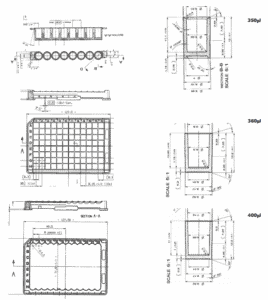
The figures below are dimensioned on the Biomat technical drawing, section of the 350 µl breakable strip format. The 360 µl and 400 µl formats are drawn separately and carry their own values.
Dimension
Value
Internal well depth
11.1 mm ± 0.05
Overall height at the section
13 mm ± 0.1
Well bottom thickness
1.15 mm ± 0.05
Draft angles
0°45’31” and 0°15’29”
Internal radii
R0.4, R0.3, R0.5
Two of these decide how the well behaves in an assay.
Draft angle. The well is moulded with a slight taper, so the internal diameter at the mouth is marginally wider than lower down. The taper is what releases the part from the mould, and it is also why the liquid column in a filled well is not a perfect cylinder. Angles under one degree keep that effect small enough that absorbance stays proportional to volume across the working range.
Flat bottom. Biomat 96-well immunoassay plates are flat-bottomed. A flat bottom keeps the liquid column uniform across the well, which is what a plate reader needs when it measures vertically through the well centre. Round and conical bottoms concentrate small volumes into a smaller area and are used for pelleting or storage rather than for quantitative optical reading.
9 mm pitch. The 9 mm spacing is what makes 8-channel and 12-channel pipettes, plate washers and automated dispensers work at all. It is also why an eight-well strip is a functional unit: a strip is exactly one column of a 96-well plate, and it can be broken off, coated separately or run separately without leaving the standard geometry.
Polystyrene colour. The wall colour decides whether light stays in the well. Biomat manufactures all three formats in three colours:
Colour
Detection mode
Reason
Clear (transparent)
Absorbance (ELISA)
Light passes vertically through the well and the plate bottom
White
Chemiluminescence
Opaque white walls reflect emitted light back to the detector
Black
Fluorescence
Opaque black walls absorb stray light and suppress crosstalk between wells
The full selection logic, including how to match surface chemistry to the detection mode, is in the Biomatmicroplate surface selection guide.
Working volume and maximum volume
The maximum volume of a well is the volume it physically holds to the brim. The working volume is the volume you can pipette, incubate, wash and read without spillage, meniscus artefacts or cross-contamination. Treating them as the same number is a common source of edge effects.
Format
Maximum well volume
Recomended working volume
96-well Breakable Strip Plate
350 µl
75 to 300 µl
96-Well Strip Plate
360 µl
75 to 300 µl
96-Well Solid Plate
400 µl
75 to 300 µl
The three formats differ only at the top of the range. Below 300 µl they are interchangeable, and they all fit the same frames, so a method validated on strips does not need to be revalidated for volume when it moves to solid plates.
The headroom is the point of the working range. Filling to 300 µl leaves 50 to 100 µl of clearance depending on the format, which is what keeps an automated washer from carrying liquid into adjacent wells.
For assay-side guidance on incubation, washing and reagent handling, see the Biomat notes ontechnical tips for ELISA.
Optical path length in a microplate
In a spectrophotometer cuvette the optical path length is fixed at 1 cm. In a microplate it changes with every fill volume. The reader measures vertically, through the liquid column, so the path length is the height of the liquid in the well, and that height is set by the volume pipetted:
path length = well volume ÷ cross-sectional area of the well
Because the cross-section is nearly constant across the working range, absorbance in a 96-well plate scales with fill volume. A well containing 200 µl gives twice the absorbance of a well containing 100 µl at the same analyte concentration, with no change in the chemistry. Three rules follow:
Pipette the same volume into every well of a run, including standards, controls and samples. A 5 µl dispensing error on a 100 µl volume is a 5 % absorbance error before the assay has done anything.
Do not compare optical density values between runs performed at different final volumes without recalculating.
To convert a reading to a 1 cm equivalent, use the well cross-sectional area from the plate data sheet. Well diameter is not fixed by the ANSI SLAS standards and differs between manufacturers, so a generic figure will not hold.
The same cross-sectional area governs binding: binding capacity is expressed per unit of coated surface, so what a well can immobilize depends on the coated area rather than on the volume. The figure for each surface is on its product page.
Why the 96-well format became the standard
The format is older than the instruments that made it useful. In 1950 the Hungarian virologist Gyula Takátsy built a plexiglass plate with 6 x 12 cups for serological testing of influenza virus, at a time when glassware and reagents were both short. In 1955 he redesigned it to 8 x 12, and 96 wells has been the reference format since.
It held for reasons that still apply:
8 x 12 matches the pipette. Eight rows is the span of a multichannel head; twelve columns is a serial dilution series with room for standards and blanks.
The volume is the right compromise. Wells in this class use enough reagent for a robust signal and little enough to make a hundred-sample run affordable.
The footprint stopped being negotiable. Once readers, washers, stackers and robots were built to 127.76 x 85.48 mm, leaving the format cost more than any improvement to it was worth. Higher-density plates kept the same footprint and shrank the pitch instead.
For an IVD kit manufacturer the practical meaning is narrower. The format is fixed and the instruments are fixed. The variables left are the surface chemistry, the optical colour, the strip format and the consistency of the lot. That is where plate selection actually happens.
Need something the catalogue does not cover? Biomat developscustom microplates and OEM plastic consumables, from surface development and 3D prototyping through to production, including private label.
Biomat manufactures surface-modified microplates in Italy under an ISO 9001:2015 quality system at company level, and supplies coated 96-well plates across passive adsorption, affinity capture and covalent coupling surfaces. The full list, with the specification of each surface, is on thecoated 96-well plates page.
ANSI SLAS 1-2004 (R2012), Microplates: Footprint Dimensions, Society for Laboratory Automation and Screening. Plate footprint and corner radius.
ANSI SLAS 4-2004 (R2012), Microplates: Well Positions, Society for Laboratory Automation and Screening. Well layout, pitch, A1 position and positional tolerance.
Auld D.S. et al., Microplate Selection and Recommended Practices in High-throughput Screening and Quantitative Biology, Assay Guidance Manual, NCBI Bookshelf. Origin of the microtiter plate and the 8 x 12 redesign.
Biomat, Technical Features of 96 Well Plates (PDF). Dimensioned sections, well capacities and frame compatibility.
Biomat product data sheets, 96-well plates. Surfaces, formats, colours, working volume.
The volume of a single well depends on the format. Biomat 96-well plates hold 350 µl in the breakable strip format, 360 µl in the strip format and 400 µl in the solid format, measured to the brim. Usable volume is always lower than maximum volume: the recommended working range for all three formats is 75 to 300 µl.
The maximum is the brim capacity of the well, which for Biomat plates is 350, 360 or 400 µl depending on the format. In practice the recommended working volume is 75 to 300 µl, which leaves headroom for washing and prevents carryover between wells during automated handling.
The footprint is 127.76 x 85.48 mm, fixed by ANSI SLAS 1-2004, with a tolerance of ± 0.25 mm near the corners. The 96 wells are arranged 8 rows by 12 columns at 9 mm spacing, with the centre of well A1 at 14.38 mm from the left short side and 11.24 mm from the top long side (ANSI SLAS 4-2004). Well diameter and depth are left to the manufacturer: Biomat breakable strip wells have an internal depth of 11.1 mm ± 0.05 and a bottom thickness of 1.15 mm ± 0.05.
Well depth is not fixed by the ANSI SLAS standards and varies between manufacturers. Biomat 96-well breakable strip plates have an internal well depth of 11.1 mm ± 0.05, with a flat bottom 1.15 mm ± 0.05 thick and a moulding taper of under one degree. The full dimensioned sections for all three formats are in the technical features data sheet.
The 96-well plate runs many small-volume reactions in parallel on a fixed geometry, so that each well is an independent reaction vessel and all 96 can be pipetted, incubated, washed and read in a single operation. The standardized 9 mm pitch is what lets multichannel pipettes, plate washers and automated readers address every well identically, which is the source of both the throughput and the comparability between wells.
They cut reagent consumption to microlitre volumes, let one operator or one instrument process 96 samples in the time a tube protocol handles a few, and hold every sample in the same optical and thermal environment. In immunoassays the well wall also acts as the solid phase on which the capture molecule is immobilized.
Yes. The general features of the wells are the same across the three formats and all fit the same well-holding frames, so a method developed on breakable strips transfers to strip or solid plates without changing instrument settings.