Come visit us at MEDICA 2026 Hall 3 Booth F53. Book a MEETING
Mouse Monoclonal Antibody Isotyping: Comprehensive ELISA Solutions for Accurate Immunoglobulin Characterization
The Critical Importance of Mouse Isotype Determination in Modern Research
Mouse monoclonal antibody isotyping involves the precise determination of both the class (such as IgG versus IgM) and subclass (for example, IgG1 versus IgG2a) of mouse monoclonal antibodies. This fundamental characterization step is essential for successful antibody research and application development.
Why Accurate Isotype Determination Matters
The determination of class and subclass of monoclonal antibodies is critically important because several key immunochemical and functional properties of antibodies depend directly on their isotype. While knowledge of the light-chain isotype (κ for approximately 95% or λ for roughly 5% of mouse antibodies) has limited practical value in most applications, the heavy-chain isotype determination provides invaluable information for researchers and biotechnology professionals.
Key Properties Influenced by Heavy-Chain Isotype:
Protein A and Protein G binding affinity – Essential for purification strategy selection
Euglobulin precipitation properties – Important for separation protocols
Complement binding and activation – Critical for functional assays
Enzymatic digestion kinetics with papain or pepsin – Affects fragmentation procedures
Serum clearance rates and pharmacokinetic properties
Antibody valence and avidity characteristics
In vivo half-life and biodistribution patterns
Strategic Applications of Mouse Antibody Isotyping
Mouse monoclonal antibody isotype determination serves as the foundation for selecting optimal antibody purification methodologies, conjugation strategies, fragmentation protocols, and long-term storage conditions. Furthermore, accurate isotyping enables researchers to predict cytotoxic properties and estimate in vivo half-life characteristics, making it indispensable for therapeutic antibody development.
Beyond research applications, isotyping provides essential quality control capabilities, including:
Lot-to-lot consistency monitoring for manufacturing processes
Contamination detection by identifying unexpected antibody classes
Hybridoma switch variant identification during cell line maintenance
Product characterization for regulatory compliance
Advanced ELISA-Based Isotyping Methodology
Technical Requirements for Accurate Isotype Detection
Mouse antibody isotyping requires the use of highly specific anti-immunoglobulin antibodies capable of detecting the different classes and subclasses of monoclonal antibodies encountered in antibody production workflows. This specificity requirement makes ELISA-based isotyping the preferred methodology for most research laboratories, as it provides both reliability and ease of use.
Comprehensive Detection Capabilities
A well-designed ELISA isotyping test provides comprehensive determination of the following mouse antibody classes and subclasses:
Heavy Chain Classification:
IgG subclasses: IgG1, IgG2a, IgG2b, and IgG3
Additional classes: IgA and IgM
Light Chain Identification:
VL-kappa chains (predominant in mouse antibodies)
VL-lambda chains (minority population)
Antigen-Independent Assay Advantages
The most convenient and rapid mouse monoclonal antibody isotyping tests utilize antigen-independent assays specifically designed for use with essentially pure monoclonal antibodies. These sophisticated assays detect antibodies of multiple classes or subclasses present in samples at measurable levels with equal efficiency, regardless of their antigen specificity. This universal detection capability makes them ideal for routine laboratory use and high-throughput screening applications.
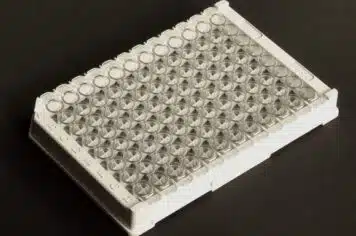
Biomat has developedMouse Monoclonal Antibody Isotyping Coated Microplate hat enable researchers to establish ELISA tests in a simple and efficient manner. Our precision-engineered 96-well coated microplates feature advanced surface chemistry that includes comprehensive protein blocking to eliminate non-specific binding sites while maintaining stable enzymatic activity over extended storage periods.
Our 96 well coated microplates on top of being coated with a protein to block non-specific binding sites and to maintain stable activity, are coated with:
goat anti mouse heavy chain (IgG subclasses 1,2a,2b,3 and IgA and IgM classes) and
goat anti mouse light chain (kappa and lambda)
Comprehensive Coating Strategy
Our microplates are professionally coated with:
Goat anti-mouse heavy chain antibodies – Targeting IgG subclasses 1, 2a, 2b, 3, plus IgA and IgM classes
Goat anti-mouse light chain antibodies – Detecting both kappa and lambda light chains
This dual-coating approach ensures comprehensive immunoglobulin characterization in a single, streamlined assay format.
Superior Performance Characteristics
Biomat Mouse Monoclonal Antibody Isotyping Coated Microplates enable rapid and accurate identification of mouse immunoglobulin class, subclass, and light chain characteristics, providing researchers with the critical information needed for downstream applications and quality control procedures.
Versatile Applications and Sample Compatibility
Flexible ELISA Strip-Well Format
The microplates can be utilized for performing comprehensive ELISA assays using strip-well plates with individual wells pre-coated with specific capture antibodies:
Goat anti-mouse light chain capture antibodies (kappa and lambda)
Rapid Results and Detection Methods
A mouse monoclonal antibody sample applied to the wells can be completely isotyped within approximately 90 minutes, making this system ideal for time-sensitive research applications. The results can be evaluated through a qualitative assessment by visual inspection of color development.
Demonstrated Performance: Typical Results
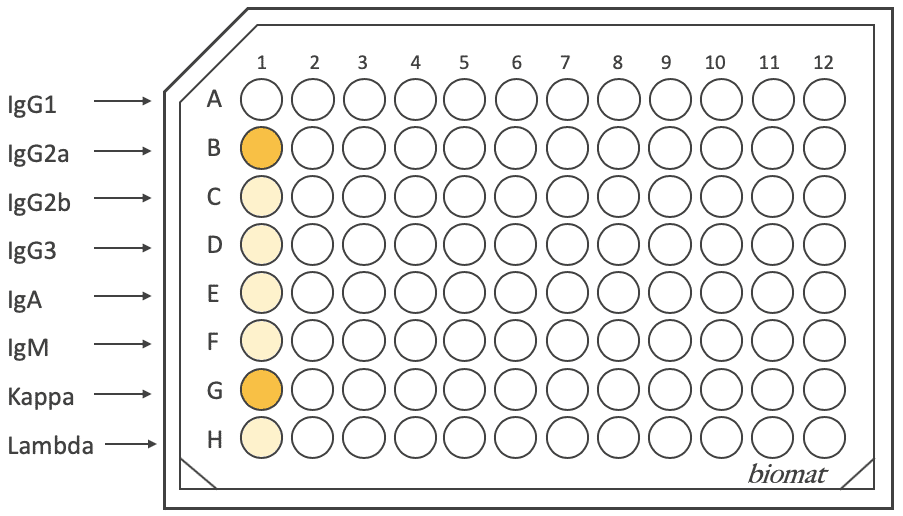
The accompanying figure demonstrates typical resolution of an IgG2aκ isotype immunoglobulin, showcasing the clear distinction and accurate identification capabilities of our isotyping system. This example illustrates the precision and reliability that researchers can expect when using Biomat isotyping plates.
Outstanding Features and Technical Specifications
The figure shows a typical resolution of an IgG2ak isotype immunoglobulin.
Innovative Strip Format Design
Biomat mouse monoclonal antibody isotyping coated plates present several advanced features that distinguish them from conventional isotyping solutions:
Convenient Strip Format:
Eight-well strip format allows convenient partial use of each plate
Use one strip (column) for each sample – accommodating up to 12 samples per plate
Reduced waste and cost-effective testing approach
Flexible sample processing for varying workload demands
Comprehensive Characterization Capabilities
Advanced Detection Scope:
Characterize specific antibodies for six different heavy chain subclasses
Identify two different light-chain types (kappa and lambda)
Complete immunoglobulin profiling in a single assay
Reliable discrimination between closely related subclasses
Superior Sensitivity and Compatibility
Analytical Performance:
Accurate sensitivity characterization with samples containing at least 1-3 ng/ml of test antibody
Broad sample compatibility using specimens from diverse sources
Consistent results across different sample preparation methods
Validated performance with quality control standards
Sample Source Versatility:
Hybridoma cell culture supernatant – Direct testing capability
Ascites fluid – Concentrated antibody sources
Purified antibodies – Final product characterization
User-Friendly Operation
Practical Advantages:
No special equipment needed to process the microplate
Standard laboratory instrumentation compatibility
Results assessment through qualitative visual evaluation
Quantitative measurement using ordinary ELISA plate readers
Straightforward protocols suitable for routine laboratory use
Quality Assurance and Reliability
Manufacturing Excellence
Biomat’s commitment to quality ensures that every Mouse Monoclonal Antibody Isotyping Coated Microplate meets stringent performance standards. Our manufacturing processes incorporate:
Rigorous quality control testing at multiple production stages
Consistent coating procedures for reliable well-to-well performance
Stability validation under various storage conditions
Batch-to-batch reproducibility testing for consistent results
Technical Support and Documentation
Comprehensive support services include:
Detailed protocol documentation for optimal assay performance
Technical assistance for method optimization
Troubleshooting guidance for challenging samples
Application notes for specialized research requirements
Conclusion: Advancing Mouse Monoclonal Antibody Research
Biomat Mouse Monoclonal Antibody Isotyping Coated Microplates represent a significant advancement in antibody characterization technology, providing researchers with the tools necessary for accurate, efficient, and cost-effective isotype determination. By combining innovative microplate design, comprehensive detection capabilities, and user-friendly protocols, these products enable laboratories to achieve superior results while optimizing their research workflows.
Whether you’re engaged in basic immunology research, therapeutic antibody development, or diagnostic assay creation, our isotyping solutions provide the reliability and performance you need to advance your scientific objectives with confidence.